

I visited Van Gogh Alive today, a multimedia exhibition celebrating Van Gogh’s artistic journey through the Netherlands, Arles, Saint Rémy and Auvers-sur-Oise, told in over 3,000 images.
With an array of connecting large-scale projections being the crowd draw, it was expected that there would be no authentic paintings on display (not to upstage all that modern tech, no doubt). What I was not expecting however was to have revelations about an artist that I thought I learned everything there was to know about from back in my school years. Van Gogh Alive was an enjoyable learning experience. Here are my favourite things I left the exhibit admiring:
- Van Gogh consistently wrote letters to his loved ones.
- Van Gogh held a reverence for Japanese woodblock printing artists, and emulated what was depicted, right down to their exact composition, through his own fastidious brushstrokes.
- Van Gogh spent one year in the mental hospital in Saint-Rémy-de-Provence and remained productive all throughout his time spent there.
- Van Gogh was remarkably prolific, creating over 2,000 artworks consisting of around 900 paintings and 1,100 drawings.
- In a letter to his mother, Van Gogh described his bedroom in Arles as “Absolute restfulness.” He painted it three times he was that enamoured with it.
- Van Gogh truly loved to write.
The main feature of the multimedia experience lasted approximately 45 minutes. Projecting on fewer screens than the cycling artworks were sentences telling of Van Gogh’s thoughts and experiences on life and creating art. On a repeat viewing, I was fortunate enough to find a chair next to one of these giant screens dedicated to his writing.
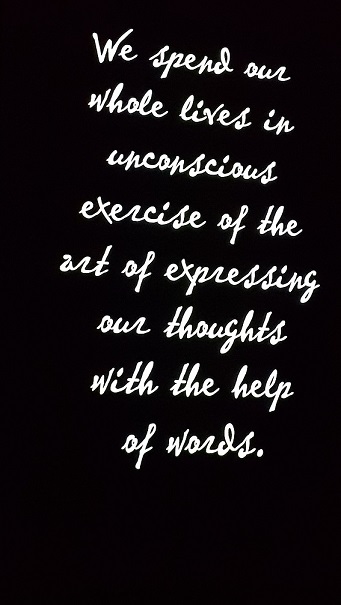 | “We spend our whole lives in unconscious exercise of the art of expressing our thoughts with the help of words.” |
| “Seeing that I am so busily occupied with myself just now, I want to try to paint my self-portrait in writing.” | 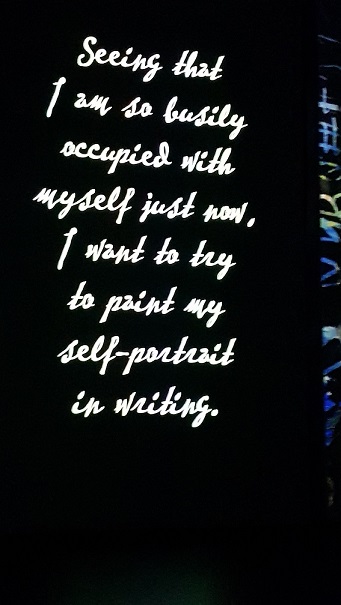 |
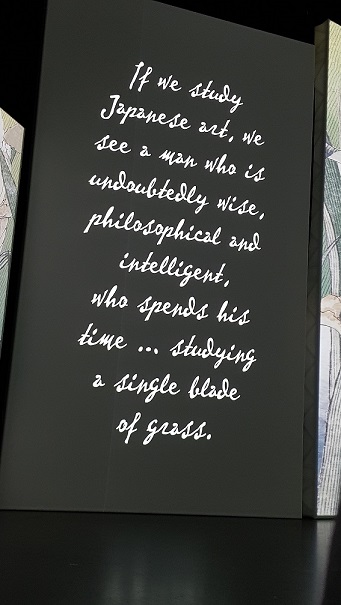 | “If we study japanese art, we see a man who is undoubtedly wise, philosophic and intelligent, who spends his time [doing what? He studies] a single blade of grass.” |
| “I can’t change the fact that my paintings don’t sell. But the time will come when people will recognize that they are worth more than the value of the paints used in the picture.” | 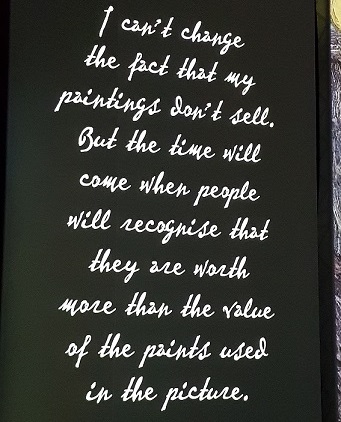 |
I suppose everyone was writing letters at the time, about love and their lives, meaning Van Gogh was not exceptional in this regard, but it was a marvelous thing that his letters were preserved and are presented alongside his paintings in equal measure.
Evidence suggests that his writing may be the reason he became so well-known in the first place, thanks in part to Johanna van Gogh-Bonger (Vincent van Gogh’s brother’s wife). After Vincent and Theo died six months apart, she read hundreds of Vincent’s letters, and published a book circa 1914, which enlivened public interest in Vincent van Gogh’s aforementioned pictures:
The Van Gogh Museum located in Amsterdam has an impressive archive dedicated to his letters, and you can follow the links below to read them all for free from the comfort of your own restful slouch:

https://www.vangoghmuseum.nl/en/highlights/letters / https://www.vangoghmuseum.nl/en/art-and-stories/stories/van-goghs-letters / https://www.goodreads.com/en/book/show/51482454-vincent-van-gogh
Being among larger than life pictures changing to the accompaniment of classical orchestral scores, that came to a close with a murder of crows, reminded me of Akira Kurosawa’s DREAMS (1990), specifically vignette #5, titled, “Crows” (feat. Martin Scorsese):
From painters to writers to cinephiles and everyone in between, truly it seems that artists will always inspire artists, independent of their longevity.
 lit-b.com