
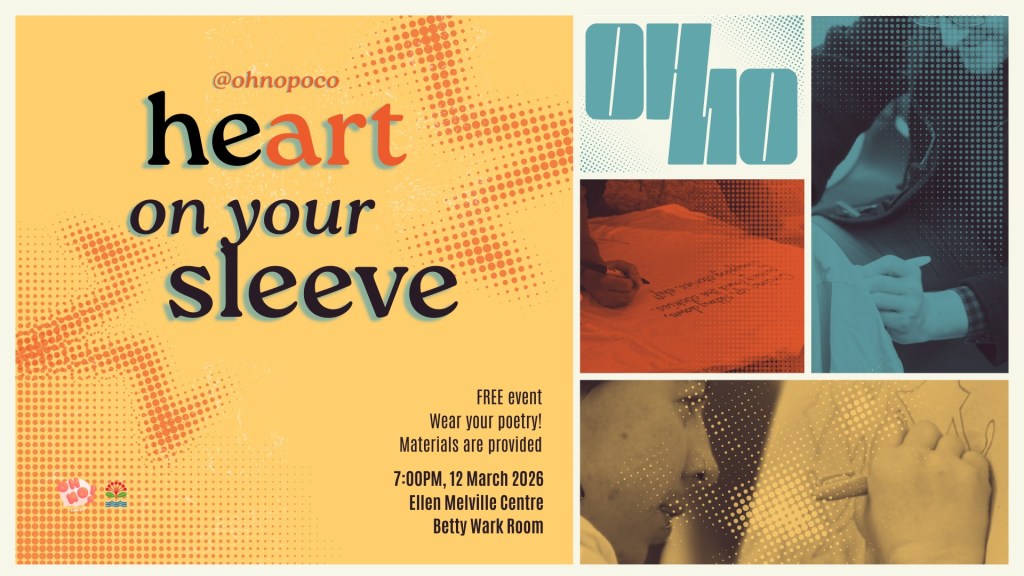
Oh No! Poetry Collective (@ohnopoco) host spoken word nights, second Thursday of every month!
Kia ora poetry lovers! Join us tomorrow night for the first Oh No! Public Poetry Night of the year, a creative, welcoming space to write, craft & share poetry together.
This month’s theme is Heart On Your Sleeve ❤️ A special T-shirt painting & poetry session where you can literally wear your words. After the crafting session, the evening flows into a relaxed open mic, where anyone who feels ready can share their work, listen to others or simply enjoy the vibe. Whether you’re a beginner, a curious observer, or a seasoned poet, all voices are welcome.
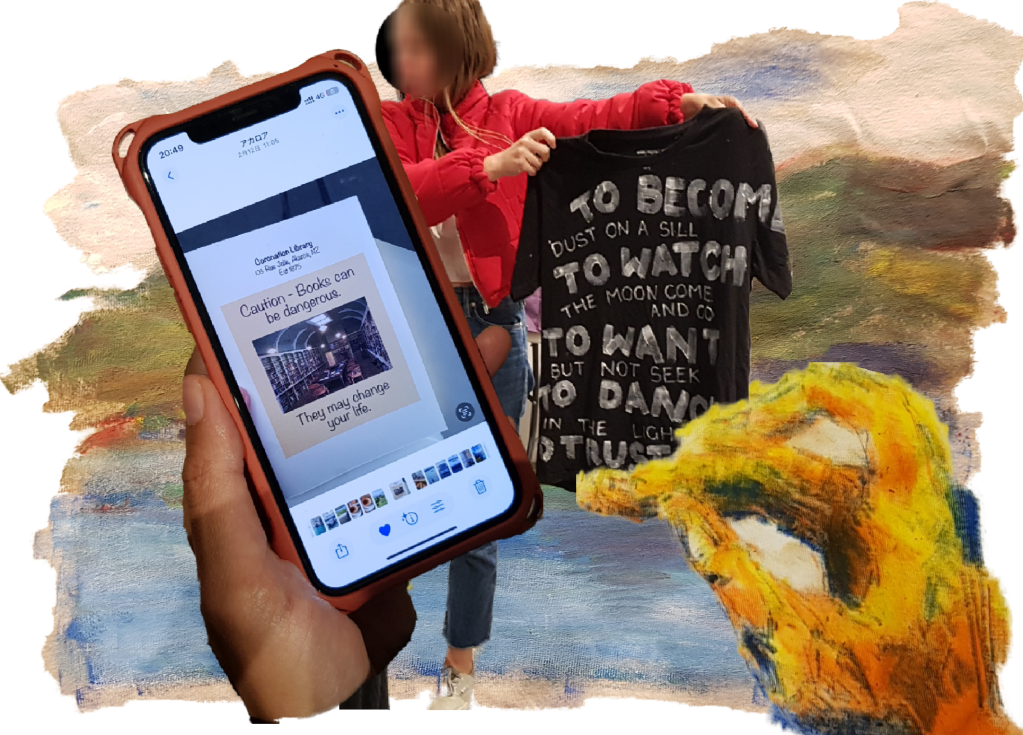
A local event to create visual poetry coaxed me away from my homebody comforts yesterday, and the opportunity to explore the neighbourhood led to discovering art along the way.
The invitation to share a poem in t-shirt form was announced to the public a month prior (I only saw the flyer a night before😅), and 10 arty wordsmiths answered the summons! Fabric markers, pastel dye sticks, and paints were provided for by two lovely hosts, Maxie & Demi. Everyone created an original artwork inspired by poetic words, and everyone shared their work with the room at the end of the night. The meet was cute.


(Should have taken more photos.)
This session was themed ‘Heart On Your Sleeve‘, to which I tried coming up with succinct verse, not difficult, but the exercise was foreshortened knowing very little about the etymology of the idiom, and what other thoughts, feelings, and imagery I could draw from. Oh No! mentioned in their promotion:
💫 The phrase “wear your heart on your sleeve” dates back to medieval times & was later popularised in Shakespeare’s Othello, symbolising the courage to show one’s true feelings openly & honestly. Come along to create, connect & wear your heart on your sleeve.
Here is a little of what I have learnt:
Between the 11th and 16th centuries, it was customary for medieval knights competing in jousting tournaments to dedicate their performance to a lady. As visible indication for the spectators, the knight would adorn himself with a personal item of hers, typically a scarf worn around the arm, or his lance. His public display of romantic intention towards the lady proved he was her champion (if he won though, amirite?). Winning while carrying a lady’s favor (scarf) enhanced a knight’s noble image. We can all understand why “heart” has long been a symbol of love and emotion, and by learning history, we see why “sleeve” was chosen in the proverb, William Shakespeare (1564–1616) popularised in the tragedy “Othello” written circa 1603.
Othello, Act I, Scene I [O, sir, content you]
Iago (a senior officer in the Venetian army under the command of General Othello) speaks to Roderigo
O, sir, content you;
I follow him to serve my turn upon him:
We cannot all be masters, nor all masters
Cannot be truly follow’d. You shall mark
Many a duteous and knee-crooking knave,
That, doting on his own obsequious bondage,
Wears out his time, much like his master’s ass,
For nought but provender, and when he’s old, cashier’d:
Whip me such honest knaves. Others there are
Who, trimm’d in forms and visages of duty,
Keep yet their hearts attending on themselves,
And, throwing but shows of service on their lords,
Do well thrive by them and when they have lined their coats
Do themselves homage: these fellows have some soul;
And such a one do I profess myself. For, sir,
It is as sure as you are Roderigo,
Were I the Moor, I would not be Iago:
In following him, I follow but myself;
Heaven is my judge, not I for love and duty,
But seeming so, for my peculiar end:
For when my outward action doth demonstrate
The native act and figure of my heart
In compliment extern, ’tis not long after
But I will wear my heart upon my sleeve
For daws to peck at: I am not what I am.
Speaking of medieval times . . . 2.6 kilometres away and inside another community arts centre, Studio One Toi Tū showcases artwork by Jessica Miku, titled, Magical Medieval Girl


Magical Girl is a subgenre of Japanese fantasy media centered on young girls who possess magical abilities. I want to see more from this artist, hopefully an expansion of this series fusing medieval lore with anime motifs worldbuilding around the Knight character specifically, because the portraits are fantastic, but nevertheless, if Jessica Miku pursues painting, I can see areas where further development will make her future works technically awe inspiring. More. The wall by the door has two small 150x150mm canvases with this promising message:
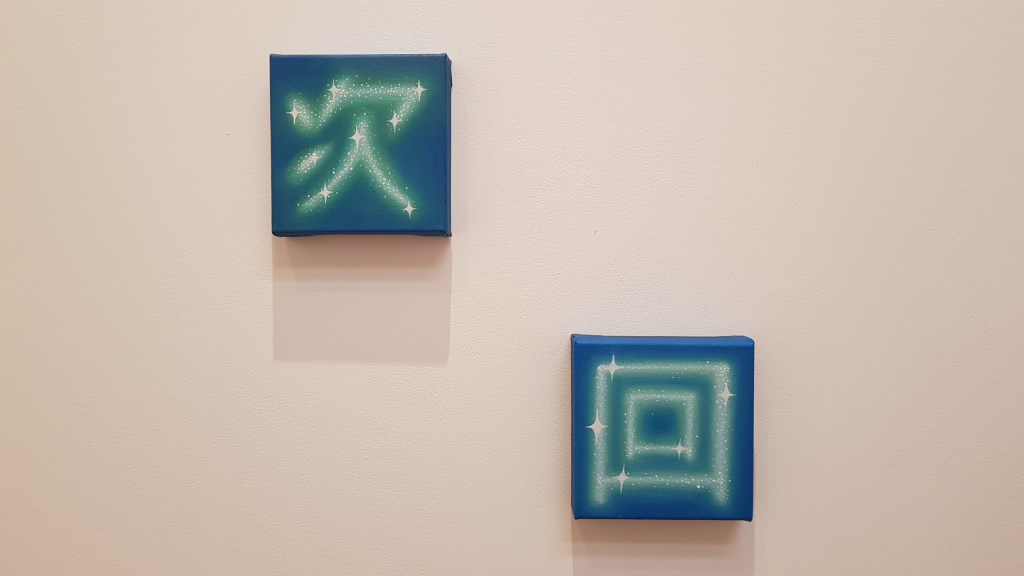
次回 (jikai) translates to “next time” in English, playing on serialised anime characters informing their audience to ‘stay tuned‘ for the next episode. Neat! ($280 for both)
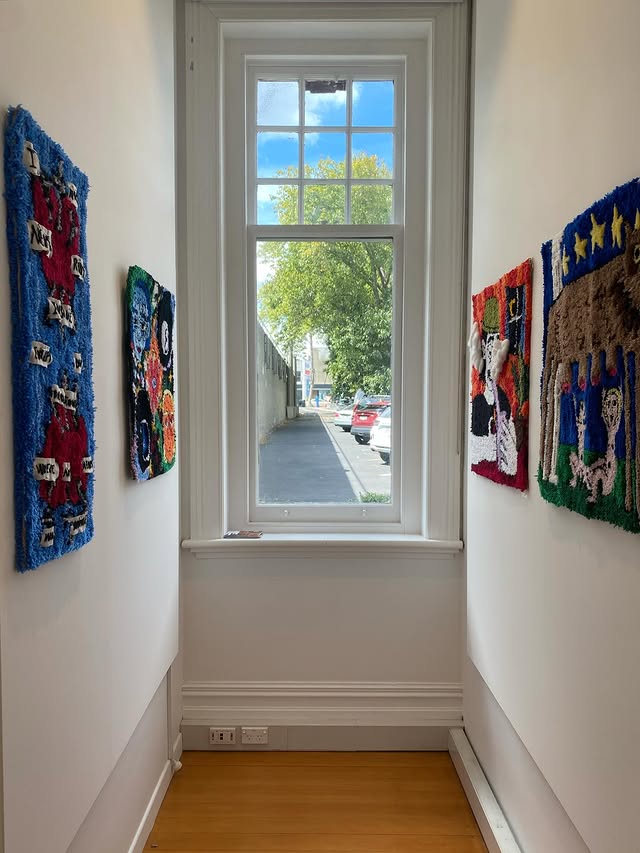
The walls in the adjacent hallway were adorned with whimsical textiles, hand-tufted by Cecilia Morera in a series titled, Life on Rugs. None were so interesting as ‘Three of Swords’ with text and medieval weaponry (again):
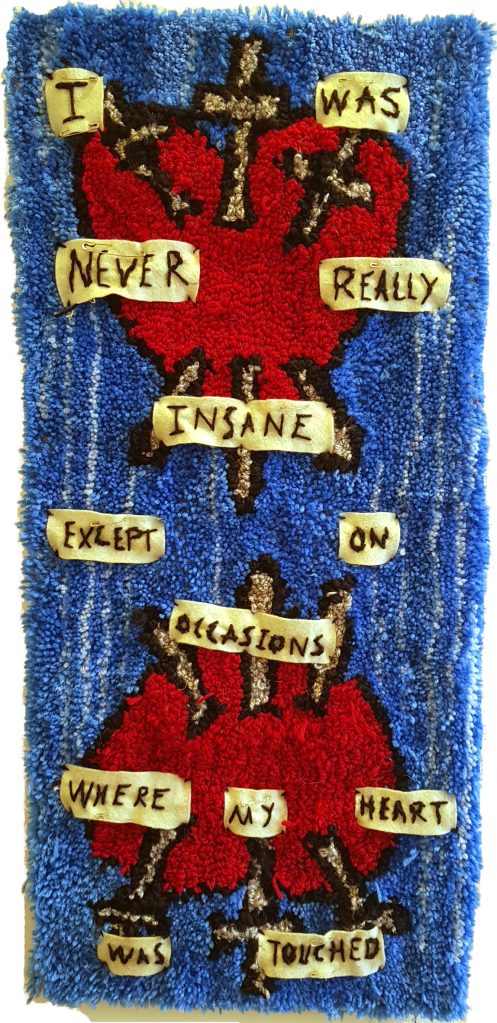
10 out of 10 would leave the house again.
It was a day of wanderlust, wearing pastel on fingers, heart on sleeve; foot rugs on walls, depicting yarn swords impaling burlap hearts; magical climbing leaves, foreign characters, and transformational text-based art. . . I feel a poem coming on.
Hearts Are Red
Skies Are Blue
Writing Is Lit
So Are You
Feet End……..
 lit-b.com